
New research disappointingly perpetuates outdated concepts of knowledge and knowledge society
Critical Eye is a semi-regular feature where RealKM analyses and discusses the methodology and science behind claims made in publications.
The concept of a “knowledge society” is associated with knowledge management (KM). There are a range of definitions, but a knowledge society can be broadly defined1 as one that generates, processes, shares, and enables universal access to knowledge that may be used to improve the human condition.
The recent paper2 “Towards the knowledge society: A definition, measurements, and limits” published in the Journal of Innovation & Knowledge examines various perspectives on the knowledge society. The authors state that “[a] comprehensive literature review and bibliometric analysis are conducted to assess dominant themes and trends in academic discourse.”
While acknowledging that there are now “updated perspectives [which] emphasise a more complex and multidimensional understanding of how knowledge operates across social, cultural and institutional contexts,” the conclusions drawn by the paper authors include:
The first contribution lies in the clarification of what is meant by knowledge from an economic perspective. Drawing on both classical economic theory and more recent developments, we argue that knowledge is not merely an abstract or philosophical construct, but a tangible asset with productive capacity. This economic framing enables a more precise understanding of the augmentation of the knowledge-creating sector…
The second main question, concerning the definition and essential characteristics of the Knowledge Society, is addressed through a broad economic lens. Rather than viewing it solely as an outcome of digitalisation or economic modernisation, the Knowledge Society is presented as a socio-technical configuration in which more and more resources are diverted from direct production to knowledge creation…
These conclusions are inconsistent with current trends in both organizational KM and KM for sustainable development (KM4SD).
1. Criticisms from an organisational KM perspective
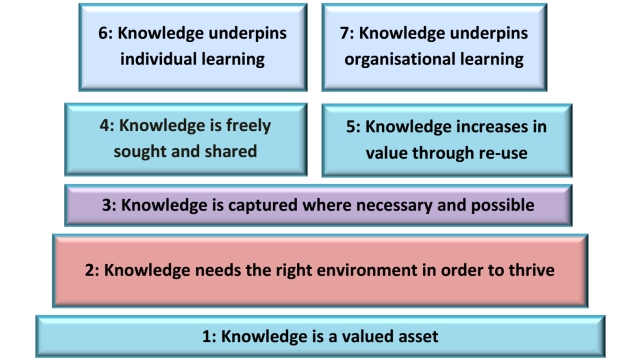
The conclusions drawn in the “Towards the knowledge society: A definition, measurements, and limits” paper perpetuate the concept of knowledge as an economic asset. However, organizational KM is moving beyond this thinking, as discussed by Hanna M. Koskinen in section 2.5 and section 2.6 of her landmark thesis3 exploring the core principles of responsible KM (rKM).
This evolution in thinking is also reflected in draft revisions to ISO 30401:2018 Knowledge management systems – Requirements4. The original 2018 version of ISO 30401 defined knowledge as a “human or organizational asset enabling effective decisions and action in context.” However, the new ISO/DIS 30401 removes the knowledge as asset concept, instead defining knowledge as “understanding that enables effective context-specific decisions and action.”

2. Criticisms from a KM4SD perspective
Section 2 of our recent paper5 “Changing the International Discourse on Knowledge and Knowledge Societies for Sustainable Development” published in Sustainable Development journal describes the evolution of three main discourses on knowledge and knowledge society:
- Techno-scientific-economic discourse – Is based on a form of technological determinism in which ICTs play an important role in shaping the socioeconomic development of society, recognizes the primacy of scientific knowledge, and is based on linear and instrumental conceptions of how knowledge generates economic growth.
- Pluralist-participatory discourse – A very different discourse championed by the United Nations Educational, Scientific and Cultural Organization (UNESCO) and others, featuring freedom of expression, universal access to knowledge, and respect for linguistic and cultural diversity.
- Transdisciplinary and decolonial discourse – An elaboration and subset of the participatory-pluralist discourse which combines transdisciplinary approaches with the decolonization of knowledge.
The “Towards the knowledge society: A definition, measurements, and limits” paper acknowledges the pluralist-participatory discourse on knowledge and knowledge society to some degree, including referencing the 2005 UNESCO World Report6 Towards Knowledge Societies. However, despite this, the paper’s conclusions are very strongly anchored in the techno-scientific-economic discourse.
International KM4SD organisations including RealKM Cooperative Limited, the Knowledge Management for Development (KM4Dev) community of practice, and Knowledge for Development Partnership (K4DP) are strongly advocating against the dominance of the techno-scientific-economic discourse, and for the pluralist-participatory and transdisciplinary and decolonial discourses. As discussed in our “Changing the International Discourse on Knowledge and Knowledge Societies for Sustainable Development” paper, this has been and continues to be the focus of the KM & Sustainable Development Goals (SDGs) campaign.
References:
- Wessels, B., Finn, R., Wadhwa, K., Sveinsdottir, T., Bigagli, L., Nativi, S., & Noorman, M. (2017). Open data and the knowledge society. Amsterdam University Press. ↩
- Cervelló-Royo, R., Devece, C., Galdón, J. L., & Lull, J. J. (2026). Towards the knowledge society: A definition, measurements, and limits. Journal of Innovation & Knowledge, 12, 100873. ↩
- Koskinen, H. M. (2025). The Emerging Concept of Responsible Knowledge Management (rKM): Identifying and Formulating the Core Principles of rKM. (Master’s Thesis, LUT University). ↩
- ISO. (2018, November). ISO 30401:2018 Knowledge management systems — Requirements. International Organization for Standardization (ISO). ↩
- Cummings, S., Boyes, B., Senmartin, D., Habtemariam, F. T., Kemboi, G., Sanz, R., Brandner, A., & Zielinski, Z. (2026). Changing the International Discourse on Knowledge and Knowledge Societies for Sustainable Development: From ‘Transforming Our World’ to the ‘Pact for the Future’. Sustainable Development, e71632. ↩
- UNESCO (2005). Towards Knowledge Societies. UNESCO World Report. ↩